





Osama Ehab Confronts the Egyptian Social Divide in ‘Glitter and Gold’
Osama Ehab’s second solo exhibition at Mashrabia Gallery interrogates a society’s desensitization of its marginalized core.

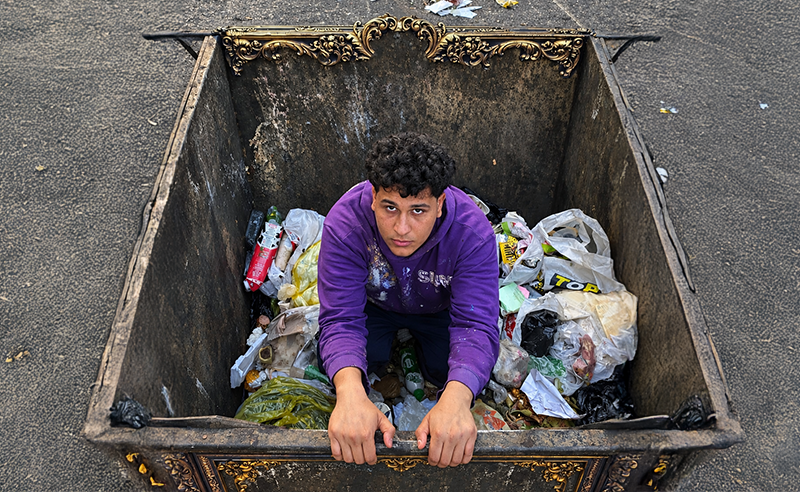
Six months before Osama Ehab’s latest solo exhibition opened at the Mashrabia Gallery of Contemporary Art, he posted a photo of himself standing inside of a dumpster, looking up at the camera with an expressionless face as though to say: just wait.
That expression was two-fold. A kind of warning, maybe—and an invitation. What he found in the dumpster, figuratively but also literally, was what an eager audience at the packed opening night of ‘All That Glitters Is Not Gold’ had come to see on September 13th: a satirical take on Egyptian urban poverty presented across 64 works of acrylic on printed photo, and another 23 ceramic installation artworks.
The exhibition, Ehab's second solo with the Mashrabia after he cold emailed its director, Stefania Angarano, who has long been on the pulse of emerging young talents in Cairo, was conceived around the time the Sharabeya native was graduating from the Faculty of Art Education and stepping out into the world.
Like most young Egyptian men, he was confronted with the task of making money so that he could, among other things, get married. Bitter reality quickly set in.
Unable to find relevant employment, Ehab instead joined his brother’s detergent store. Some of his friends turned to collecting aluminium cans to make money. Over the phone, Ehab said he found it all a little strange. “Have we really all become this?” he asks.
“There’s no shame in that,” he then answers himself. “But if that’s what we’ve all become, let’s, I guess, change it.”
Speaking to Ehab before the exhibition, he says he wants people of all classes to put themselves in others’ shoes, but also claims “this isn’t an awareness project.” Nonetheless, he has succeeded in creating an exhibition that can more than speak for itself.
At the base of each of Ehab’s acrylic artworks is a different photograph, only a small portion of which are his own. While Ehab was embedding himself within Cairo’s recyclers and scavengers whose sources of income were the project’s initial focus, he also spent the better part of a year scouring two decades of web articles and social media posts for photos documenting the Egyptian street and its opaque value systems.
In one photo, for example, a boy is hanging upside down from the hand straps of a Metro car. In another, a man is asleep on the sidewalk, his back and tattered clothes facing the viewer. One is itself a screenshot of a photo, a meme where a man urinating on a wall is superimposed with advice about ‘free urine analysis’.
It is not exactly poverty porn, and not all of the photos have to do with poverty or hardship (one photo is of Cairo’s under-construction Monorail), but what does seem to unite the photos is that they are, aesthetically, quite ugly. Low resolution, drab colours, most wouldn’t warrant a second look.
Ehab’s interventions, in glittering acrylic gold, are what keep you looking. They are neither conceptually demanding nor visually demanding. Instead, they are precise, pointed and often playful, guiding your eye to what is obviously there but just as often asking you to see what is not there.
Ehab isn’t poking fun at the subjects depicted in the artworks. It’s satirical because his use of gold makes the audience see what they have previously failed to see, or have become desensitized from seeing.
The Shakespearean title holds the intention: shiny objects aren’t always valuable, but if I make these objects shiny for you, maybe you’ll see the value in them?
That same trick is found in the frames containing the artworks. Ehab spent more on this exhibition than he did on any of his previous work, mostly because he insisted on placing all the presented pieces inside elaborate, gilded frames.
This had the effect of creating what today’s internet would term a ‘rare aesthetic’: the salon modhab of many generations of Egyptian homes that transcends class and ignores taste.
Just as the trash of the scavengers isn’t really gold but is, to its finders, a sort of treasure, this gilded furniture isn’t treasure, even if it really does contain gold flakes in its giltwood.
A major component of the exhibition is also the installation work, 23 ceramics pieces made by artist Omar El Gazar in collaboration with Ehab. It was El Gazar who took the photo of Ehab inside the dumpster.
Sprayed with gold paint, these hyper-realistic ceramic pieces are replicas of trash: discarded crocs, soda cans, water bottles, and yoghurt cups sourced by the artists from garbage heaps. The stands on which they’re set are similarly built for realism, crafted from hundreds of discarded cans that Ehab collected and compressed—a process usually done on the industrial scale at recycling facilities.
Like the salon modhab furniture, they have been made pretty by the addition of fake gold. Remove that glittery layer and it is hard to describe the ceramics, or your grand-aunt’s salon, as very beautiful. How flimsy then is our appraisal of worth, and how thin is fate—these seem to be the main questions of the exhibition.
Ehab’s portrayal of marginalization, and of people’s faces, can quickly become thorny. In some of the frames, he blots faces out with paint or water smudges, though not all pieces are given this treatment.
For instance, a congratulatory billboard depicting the faces of female university students was kept unblurred. To Ehab, the fact that this was already made publicly viewable is the reason why he has the right to use it now without smudging out the students' faces.
Nonetheless, Ehab isn’t dealing with anything any Egyptian hasn’t already seen before. He’s only taken it, foregrounded it, and found in each frame a precise intervention that turns the question back at the audience: aren’t you seeing this too?
‘All That Glitters Is Not Gold’ is running at the Mashrabia Gallery of Contemporary Art until October 8th, 2026.
- Previous Article Chef Paul Farag Once Avoided Middle Eastern Food. Now He Embraces It.
- Next Article Inside One of the World's Best Kitchens ft. Paul Farag