




Ezz Monem Built a Museum of Things Thrown at Politicians
Egyptian artist Ezz Monem recreates 36 objects thrown at political figures across 132 years, turning shoes, food and other projectiles into a fictional museum archive.
There is a specific term in the Greek language for throwing yoghurt at someone in order to humiliate them. The term is yaourtoma, and the practice has a long history; it was even included in legislation dealing with juvenile delinquency in 1958.
Greek justice minister Haris Kastanidis was attacked with yoghurt while watching a film at a cinema in Thessaloniki during anti-austerity protests in 2011.
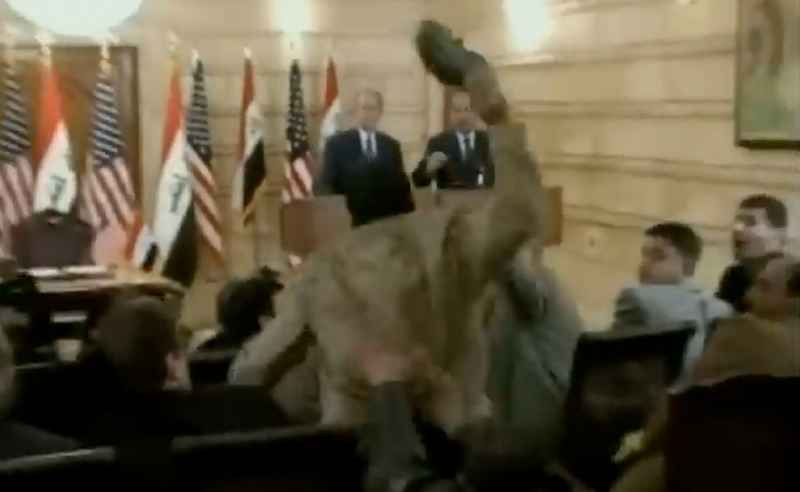
A shoe carries a different insult rooted in local culture in Iraq. Iraqi reporter Muntadhar al-Zaidi hurled both his shoes towards US President George W. Bush during a news conference in Baghdad on December 14, 2008.
Protesters in Alexandria threw tomatoes and shoes towards Hillary Clinton’s motorcade during her visit to the US consulate four years later.
“These were the only two incidents I could find in the region,” Egyptian artist Ezz Monem says. “We don't really have the same culture of throwing things at politicians here, at least not to the extent you see elsewhere.”
These incidents are among the 36 objects reconstructed in Museum of Disruptions, Monem’s ongoing project examining what happens when ordinary objects become political gestures.
Its first chapter, Archive of Thrown Objects, was shown at Conners Conners in Melbourne from July 2 to August 1, 2026. Monem recreates objects thrown at political figures and photographs them as though they had been recovered, catalogued and preserved by a museum.
“I envision Museum of Disruptions as an ongoing project, developed through several iterations,” Monem tells CairoScene. “The second chapter, planned for 2027, will shift towards collective acts of disruption and how these events are documented and represented in newspapers.”
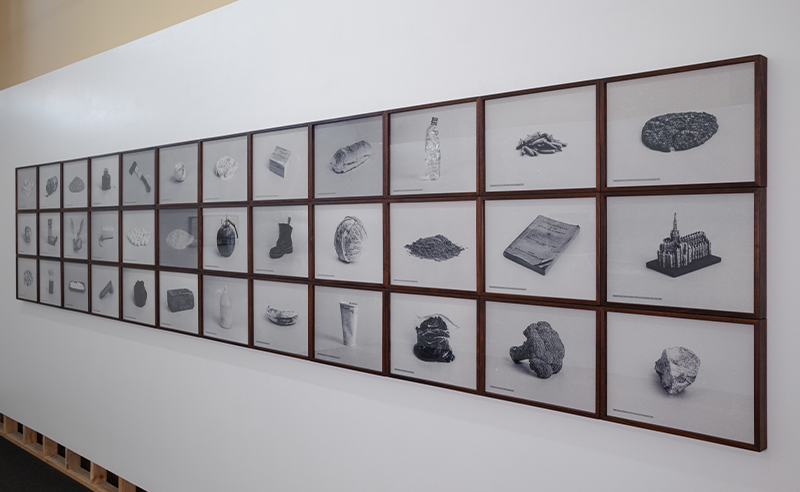
Monem's photographs present ice cubes, books, adult toys and other objects without the crowds, politicians or circumstances that gave them their meaning.
 “I wanted to create a fictional institution, as if someone had collected these objects and made an archive of them,” he says. “I like creating that tension where someone looks at a photograph and asks: is this the real object, or has it been recreated?”
The archive spans 132 years, from a gingerbread biscuit thrown at British Prime Minister William Ewart Gladstone in Chester in 1892 to incidents recorded in 2024. The politicians represented include Winston Churchill, Richard Nixon, Justin Trudeau, Silvio Berlusconi and Keir Starmer.
“The main inspiration was the video of Muntadhar al-Zaidi throwing his shoes at George W. Bush,” Monem says. “I was working on a video installation about authority, and that incident was one of the scenes I was considering. Then I went down a rabbit hole.”
Monem began with a Wikipedia page documenting incidents where objects had been thrown at politicians, then researched each one and found others.
“There wasn't really a strict system for choosing the objects. Sometimes it came down to the historical significance of the incident, and other times it was simply how unusual the object itself was,” he says.
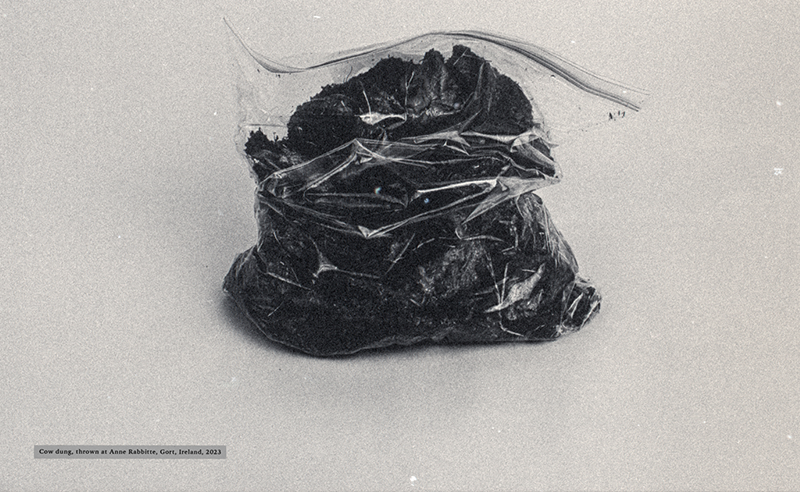
The search uncovered a remarkably varied collection. Alongside the yoghurt and shoes were an IKEA stuffed wolf, a pig's head, a cabbage, a gingerbread biscuit, a sex toy, a block of wood and a miniature replica of Milan Cathedral.
“Every simple action had so much background to it,” Monem says. “There was always a reason why it happened. Sometimes I would find a video of the incident, sometimes just a photograph, and sometimes there was hardly any visual documentation at all.”
Some objects were thrown in protest, others to humiliate or injure. One mango came with a very different request.
Marleni Olivo flung a mango at Venezuelan President Nicolás Maduro as he travelled through Maracay in April 2015. Her name and telephone number were written on the fruit alongside “Si puede me llama”, meaning “If you can, call me.”
Olivo was seeking help obtaining housing. Maduro later announced that she would receive an apartment.
“What interests me is the moment an ordinary, everyday object takes on political significance simply because of the act of throwing it,” Monem says. “A shoe is just a shoe until someone throws it at a president. An ordinary object suddenly it carries a political meaning far greater than its original purpose.”
 When photographic evidence was available, Monem tried to recreate the original object closely. He studied photographs of a wooden block thrown at Donald Trump’s motorcade in Florida in 2017 closely enough to reproduce its grain lines.
One of the most difficult objects to find was the souvenir statuette of Milan Cathedral used to strike Silvio Berlusconi in December 2009. The former Italian prime minister suffered a fractured nose and damaged teeth after being hit following a rally in Milan.
“I spent a very long time looking for the Milan Cathedral souvenir,” Monem says. “Eventually, I found one in the United States.”
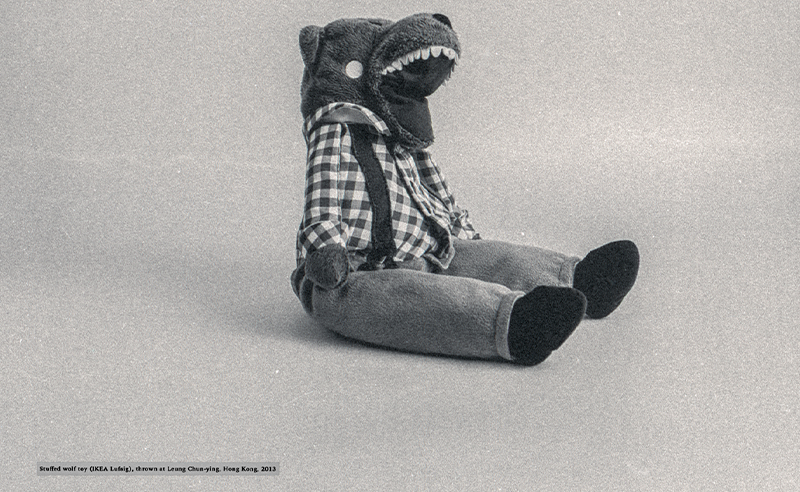
Monem sourced the IKEA Lufsig wolf thrown at Hong Kong chief executive Leung Chun-ying in 2013 through online marketplaces. His political opponents had nicknamed him the Wolf, and the toy sold out after the incident.
Other objects were easier to source. Monem turned to a local butcher to reconstruct the pig's head thrown towards Samoan Prime Minister Tuilaʻepa Saʻilele Malielegaoi in Brisbane in 2018.
Repeated projectiles created another problem. Eggs have appeared in numerous confrontations with politicians.
“If I found ten incidents involving eggs, I would choose the most significant one,” he says.
The photographic installation contains 36 archival pigment prints mounted in custom blackwood frames and stretches approximately five metres across the gallery wall. Each image adopts the visual language of museum documentation, leaving much of the surrounding incident outside the frame.
“I researched the people who threw the objects, but I decided not to mention them directly in the work,” Monem says. “I wanted the object to speak for itself, to show how something so ordinary could, in a single moment, become a symbol of political defiance.”
The shoes that inspired the project proved especially difficult to reconstruct.
Several manufacturers claimed to have made the shoes al-Zaidi threw at Bush. Turkish manufacturer Ramazan Baydan identified them as his company’s Ducati Model 271, later referred to as the Bush Shoe or Bye-Bye Bush. Other manufacturers disputed the identification, and the original shoes were destroyed during security examinations.
“For the George W. Bush incident, I really wanted to find the shoes,” Monem says. “But there were manufacturers in Iraq and Turkey claiming they had made them, and there was no way for me to verify which pair was correct.”
Unable to establish what the shoes looked like with sufficient certainty, Monem changed his approach.
He created Press Conference at the Prime Minister’s Palace, Iraq, 14 December 2008, showing the room where the incident took place with everyone from the original footage removed.
“I began with a still image from the televised press conference and digitally erased the journalists, politicians and security staff,” Monem says. “After that, I rebuilt the architectural details that had been concealed behind them.”
 The connection between political gestures and collective action is personal for Monem. He witnessed Egypt’s 2011 revolution.
“It was a defining moment in my life,” he says. “It changed the way I looked at the power of collective actions and their success.”
Monem grew up in Cairo, where his family lived in Old Cairo before moving to Sheikh Zayed. He worked as a software engineer and shared a studio in Mounira with other artists.
He moved to Australia in 2016 and later completed a Master of Contemporary Art at the Victorian College of the Arts, University of Melbourne. He now works in fraud detection at National Australia Bank.
“Engineering helped me understand how to solve problems,” he says. “This is one of the most valuable lessons I applied to my art practice.”
That background feeds into Physics Lesson, a 12-minute video shown on a cathode-ray-tube television as part of Museum of Disruptions.
The fictional educational programme explains projectile motion through velocity, force, distance and gravity. Its format recreates revision programmes once shown on Egyptian national television for students preparing for exams.
“The film recreates the format of the revision programmes once shown on Egyptian national television for students getting ready for exams,” Monem says. “I remember that the presenters went through the subjects and gave students the assurances that these are the exact topics they will find on the exam paper.”
“A very small movement can cause damage,” he adds. “But the same movement can have political charge as well.”
Drama teacher and friend Dan Hawkins acts as the programme’s presenter. Monem first recorded the lesson digitally, then re-recorded it using the same VHS camera he had used as an engineering student in 2007.
“Some of the visitors at first mistake the video for an archival film until they see the actor in real life in the gallery,” Monem says.
Alongside Physics Lesson is Berlusconi's Two Broken Teeth and Bandage, a small bronze-and-clay sculpture depicting the aftermath of the attack on the Italian politician.
Monem bought ceramic teeth for the work, which was produced with Brigit Ryan and cast in bronze at Mal Wood Foundry.
“I needed something that would remind people of this incident without showing the picture of Berlusconi after the attack,” he says. “Bronze seemed to be the right material for that.”
Monem wanted the museum to combine different kinds of evidence: photography, sculpture and moving image.
There are so many ways you can throw a shoe.
- Previous Article Faraj Suleiman Teams Up with Nine-Year-Old Niece on New EP ‘Sama’
- Next Article Saudi Artist Alif is Sculpting Out the Arabic Letters
Related Articles

Trending This Week
-
-

-
 Nov 09, 2026
-