



Meet The Curators Who Built the UAE Venice Pavilion Out of Whispers
Bana Kattan and Tala Nassar asked six artists to interpret 'washwasha', the Arabic word for whisper, in their own artistic language at the UAE's Venice pavilion.
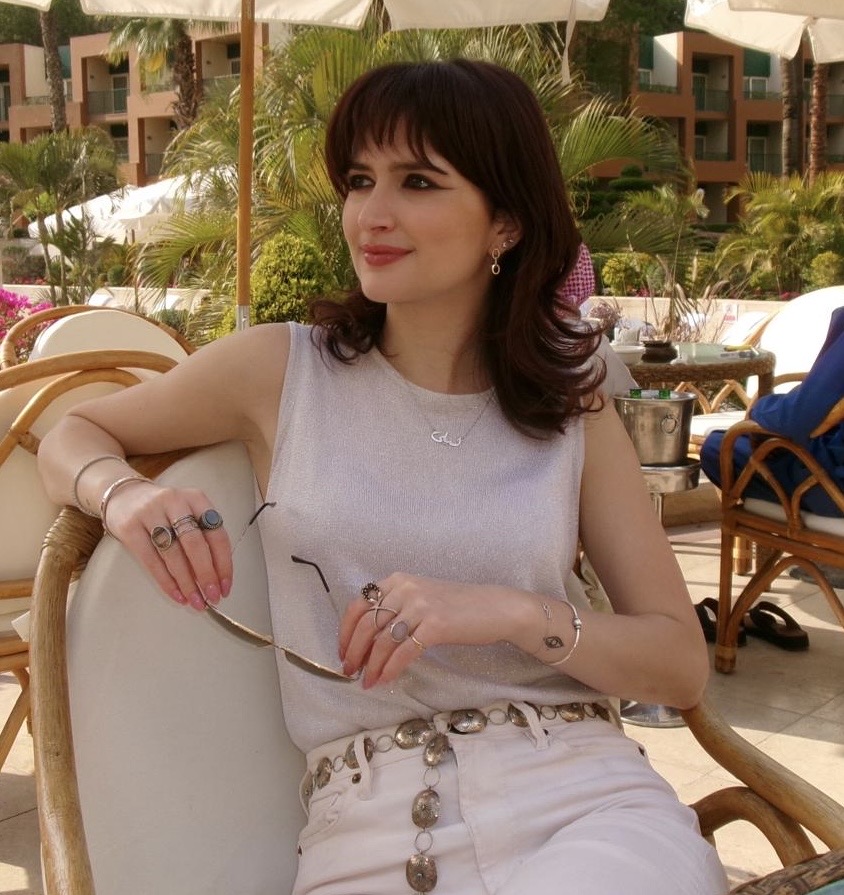
‘Washwasha’, or ‘whispering’ in Arabic, is the exhibition name head curator Bana Kattan and assistant curator Tala Nassar chose for the UAE Pavilion at the 61st Venice Art Biennale. The duo came up with the concept together, the fruit of a relationship that began back in 2018 when Nassar worked as Kattan’s intern at the NYU Abu Dhabi Art Gallery.
Fate kept bringing the two together. They met again in Chicago while Kattan was working at the Museum of Contemporary Art in Chicago, and Nassar was studying for her master’s. Then, their project was the one chosen from several applications to represent the UAE at the largest art exhibition in the world.
Before they chose the artists, the name - ‘Washwasha’ - grounded the project. The pavilion, they decided, would be dedicated to the intangible medium of a whisper: sound. And they were also geeks for the linguistics of it all.
“Washwasha is an onomatopoeia, and the Arabic language actually doesn't have a lot of onomatopoeias, which often play the role of filling in when you don't have the right word,” Kattan said. An onomatopoeia is a word that imitates the sound it is trying to describe, like ‘bang’ or ‘clash’, for example. “But then what made it more special was the fact that it's a four-letter root,” she continued, which is uncommon in Arabic, where most words are constructed of three letter roots.
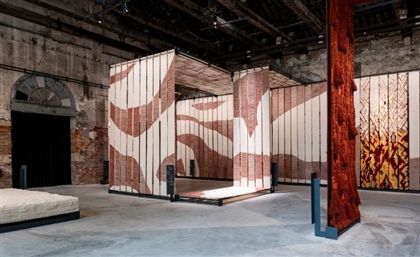
Language - spoken, heard and felt - draws the thread between each of the six artist’s installations. The curators put each piece in conversation with the other. They did not make the art, but they deliberated over where to place it, over which room would hold what chapter so that the entirety could tell a cohesive story.
“The audience does not get the full experience unless they spend five hours in the space, which is extremely rare in the art world,” Nassar said, referencing the audio pieces that run on a loop. “They will get a different experience every time they go back.”
The curators gave the artists their freedom to interpret the theme how they pleased, but the process was “very much an artist-curator partnership,” Kattan said.
The six exhibiting artists are Mays Albaik, Jawad Al Malhi, Farah Al Qasimi, Alaa Edris, Lamya Gargash and Taus Makhacheva. Instead of trying to explain each installation, Kattan and Nassar decided it would be better to show me. On our Zoom call, each of us in different countries, none of them Italy, the curators took me on a virtual tour of the Pavilion through a 3D model their team had created.
The pavilion was designed by Büro Koray Duman Architects (B—KD), led by Turkish-American architect Koray Duman himself. He worked with the artists and curators to draw up a floor plan that would ensure the four sound installations wouldn’t bleed into each other, and to support the narrative storytelling of the exhibition as a whole.
Walking up to the pavilion’s facade, one first encounters a zig-zag bench by contemporary Russian artist Makhacheva with headphones attached to a 30-minute audio one can sit and listen to. It is part one of her piece ‘And What Did You Say?’, with part two being a performance that took place over the course of eight showings where “three performers embodied the life cycle of a rumour,” the pavilion’s Instagram described.
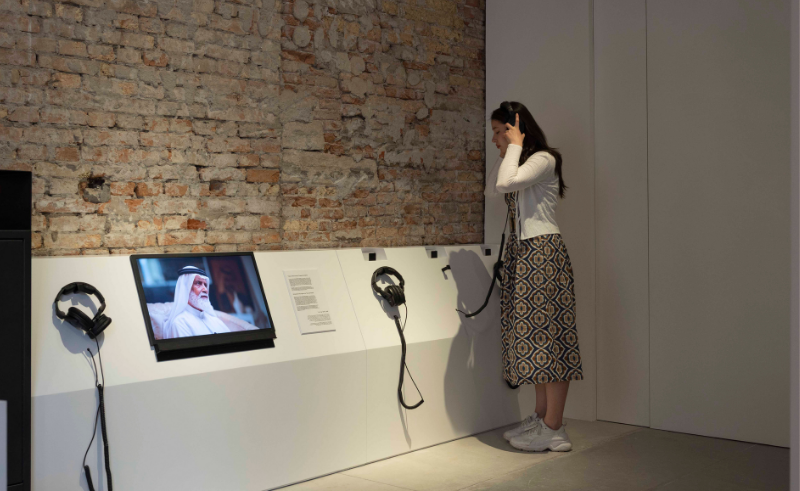
Past the bench, one enters Palestinian artist Al Malhi’s recreation of Hammam Al Ayn in occupied East Jerusalem, titled ‘Naiman.’ On a curved bench beneath a replica of the bathhouse’s original dome, visitors are invited to take part in a conversation with older men reminiscing on the rituals they took part in before their wedding day.
A hallway then leads you to the courtyard, the largest room in the middle of the pavilion, that hosts three installations. It opens with a piece that titles itself after a Mahmoud Darwish poem that “contemplates the deep entanglement between language and being,” Palestinian-Syrian artist Albaik writes on her website. Kūnī kay akūna kamā aqūl!” (“Be, so that I may be as I say!”) names a series of 19 glass sculptures that are moulds of the inside of Albaik’s mouth, capturing the moment she tries to say a word.
“She was trying to locate language in the body and trying to capture language at the moment of its formation,” Nassar said. While it is not an audio installation, the work explores spoken language. “It asks what happens when you try to capture sound and turn it into something physical. You're actually losing the sound in the process, and so it's a reflection on oral histories: what happens when you archive them and what is lost in that process.”
Albaik captures her attempt at two sentences in the glass bulbs, one on a black table and another that hangs like lightbulbs from the ceiling directly above: The former, “ana lughati” (“I am my language”), and the latter, “Kun fa yakun”, a well-known Quranic phase that means, “Be, and it is.” It takes the shape of the Pleiades star cluster called ‘Thuraya’ in Arabic.
“It’s a piece about identity, and what becomes of identity when someone is born into exile,” Nassar said, “And for a Palestinian, identity is very much tied to language, because there is no physical tie to the homeland.”
In another exploration of identity and belonging, Emirati artist Gargash hangs her photo series ‘Majlis’, or ‘living rooms’, on the adjacent walls. Each sit in a box frame, two on one wall, four on the other. Some living rooms are decadent and formal, others are private and casual, like the couches in her grandfather’s living room.
The film in the same courtyard belongs to Emirati artist Al Qasimi, titled ‘The Curse’. The sound fills the room on a nearly 20-minute loop over four screens on a red curtain backdrop - a mouth, an eye, an egg, and the largest, a TV. The film follows the story of a child who believes that their scream brought a curse on their village. “This piece really fluctuates in sound,” Kattan said. “It has very quiet and personal moments, and then it has these big outbursts of performance.”
Leaving the courtyard to the right of the screen, visitors walk down “a very purposefully dark hallway,” Kattan explained. One’s eyes might take a moment to adjust from the bright white courtyard to the dark, seemingly cornerless room next door that houses Emirati artist Edris’ ‘Wiswās’. It is another word for whispering in Arabic, the obsessive, intrusive-thoughts counterpart to the audible ‘Washwasha’.
“The volume of the piece is quite loud, so every one of your senses is heightened,” Kattan said about the robotic recording - a surround-sound manifestation of the voices in your head. The three iroko wood masks on the wall are the only thing illuminated in the room, with animatronic eyes that rotate around the room in a clockwise direction.
“This piece very much talks about anxiety, which leads to Taus very nicely,” Kattan said. Taus is the artist who opens and closes the pavilion, with another audio-based installation in the last room made of 52 speakers. “It's the opposite of the robotic and technology noises - you hear the noise of human chatter.”
“I'm gonna tell you what somebody told me when they were on the other side of the curtain,” Kattan laughed. “They were like, ‘It sounds like there's a party in there, I wanna go!’ And then they opened the curtain, and it was literally nobody - just all of these speakers.”
The piece is titled: ‘Dear R., R., K., S., M., A., C., S., K., I., G., L., A., A., L., P., G., E., J., D., M., C., B., O., F., F., R., D., M., E., L., I., F., L., A., M., T., K., K., L., P., F., V., A., L., L.’
Each 3D-printed speaker is about the size of a phone and reads a real apology email for not responding sooner written during the COVID-19 pandemic. “The artist reached out to her network, and they gave her a variety of excuses that they've used,” Kattan said, pointing to excuses like, “I'm sorry for my late response, I just had a baby,” or, “I'm sorry for my late response, I lost faith in time.”
“When you hear it all together,” she continued, “it's this cacophony that touches on our hyperconnectivity and how we cannot go two days without apologizing for our late response.”
“‘Washwasha’ is just one word and look at all the directions the artists took it in,” Kattan said. She was sure to clarify, however, that “this exhibition is definitely not a survey of the UAE art scene. It's just a snippet.”
“And the world doesn't need another checking-all-the-boxes show, you know?”
Kattan and Nassar’s curatorial work for ‘Washwasha’ will be on display until the end of the Venice Biennale, on November 22nd, 2026.
- Previous Article Arab Athletes Are Off to a Flying Start at the Mediterranean Games
- Next Article The Intricate Beauty of Ben Youssef Madrasa
Related Articles
Trending This Week
-
 Oct 06, 2026
 -
-
-