






Egyptian Artist SAKRAN Asks: Who Gets to Call Something Bee2a?
Egyptian artist SAKRAN turns six years of research into a photobook examining how class, globalisation and Western taste shape what Egyptians call bee2a.

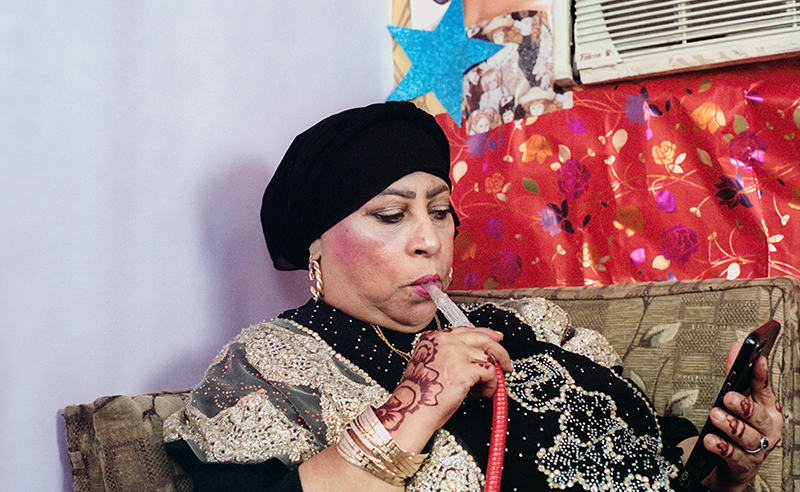
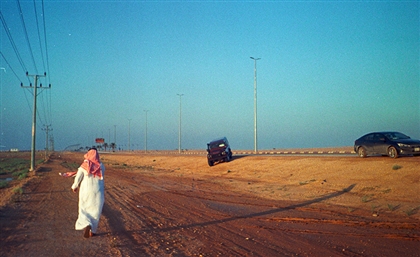
A galabeya bearing a fake Versace logo on the streets of Cairo can be dismissed instantly as a knockoff, tacky or, in the Egyptian slang at the heart of this story, 'bee2a'.
Egyptian multidisciplinary artist SAKRAN, aka Hana Saleh, has spent six years researching Egyptian kitsch, what constitutes bee2a and the class dynamics that give those labels their meaning. This year, she turned that research into a photobook.
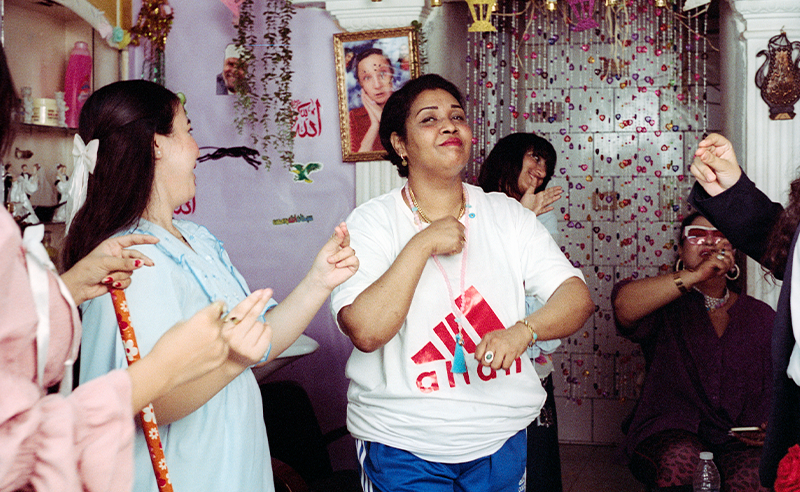
Kaherty, with the subtitle Learning to Flourish Within a Schizophrenic Culture, spans photography, visual research and philosophy, and the first edition has already sold out. The book carries a staged photographic series centring Egypt's struggling classes alongside a visual language drawn from familiar Egyptian objects: logos, typography, clothing and everyday visual culture.
"In my older works, the idea of kitsch to me was simple and basically meant knockoffs," SAKRAN tells CairoScene. "But the more I dig in, the more it turns out that kitsch is a philosophy."
The German term 'kitsch' has long carried associations with cheapness, trash and poor taste. Twentieth-century art criticism used it to describe mass-produced items, sentimentality, commercial culture, imitations and poor taste. Kitsch has assumptions attached to it, and whoever labels something as such has already told us how seriously it should be taken.
In SAKRAN's reading, Western kitsch became increasingly associated with pleasure, excess, sentimentality and consumer culture, including the material aspirations attached to the American Dream. For her, while bee2a and kitsch are not interchangeable terms, kitsch does provide an aesthetic framework for understanding why certain things are labelled bee2a in Egyptian culture.
-1584718d-1048-44f7-858b-8463c78e58fc.png) While bee2a is a social judgment applied to people, objects and behaviours, kitsch helps identify the aesthetic qualities behind that judgment. Through her research, SAKRAN found that the things Egyptians commonly describe as bee2a often share characteristics such as excessive sentimentality, repetition, childishness, visual excess and exaggerated emotional expression, all of which have historically been associated with kitsch. SAKRAN uses the latter to examine the aesthetic patterns underlying a distinctly Egyptian social judgment.
Bee2a can refer to clothes, accent, weddings, songs, restaurants, interiors, haircuts and behaviour. Egyptians can even use the word in reference to members of their exact same social and economic circles, finding increasingly minute ways of locating one another on an imagined scale.
To SAKRAN, what someone is actually communicating when they use the term bee2a is that they are "describing their own trauma." Underneath the word is a fear of being too close to it, an anxiety about proximity. When someone labels something bee2a, they also look at themselves and ask: am I the same? Can somebody mistake me for that?
"The upper class is the one that decides what is considered good or bad taste," SAKRAN says. "This idea comes from Bourdieu's sociology. The people who have more cultural and social authority are the ones that set the standard, and everybody else is judged according to it. In Egypt, this issue is even more complicated, because some of the upper class are so Westernised that they get their standards from somewhere else, and then judge the aesthetics in Egypt as bee2a."
The name of the photobook, 'Kaherty', can be translated as 'My Cairo', from Al-Qahira, the Arabic name for Cairo. SAKRAN also plays with the root q-h-r (قهر), meaning to overpower or subdue, reading Kaherty as carrying the additional sense of 'my conqueror'. Cairo becomes both the city she claims as hers and one that bears down on her.
SAKRAN's fascination with the subject started in 2020 when a search for traditional galabeyas led her instead to garments decorated with Western luxury logos. Curious about where the older designs had gone, SAKRAN went down a rabbit hole trying to understand why Western logos had replaced them, what that shift said about class and taste in Egypt and how globalisation was reshaping the country's visual culture.
 She recorded her thoughts in a paper titled 'A Stand Against Deculturation: How Everything Is Kitsch and Egypt Will Lead the Way', published later that year, and then developed into a photography project in collaboration with Egyptian photographer Zeinab El Tawil.
Her 2020 paper is centred on a visible contradiction. Animal prints, fake labels, sentimental objects, bright colours and decorative excesses are generally considered poor taste in Egypt, while exactly the same visual codes are used in global fashion and celebrity culture under entirely different descriptions.
For example, SAKRAN compares a traditional Egyptian galabeya printed with tiger prints to Kourtney Kardashian's Roberto Cavalli outfit and an overcrowded Egyptian shop window full of teddy bears and hearts to Rihanna's Savage X Fenty Valentine collection. She is interested in the moment when the visual language moves from bee2a to desirable, and who had the authority to declare that whether it is now fashionable and "camp".
In her 2020 paper, SAKRAN connects this anxiety around class to Egypt's recent economic history. She focuses on the Infitah, Anwar Sadat's economic opening, and the changes in imports, consumption and social mobility that followed. In her reading, those shifts sharpened the role taste could play in marking class distinctions, expressed through labels including bee2a, "new money" and ibn nas.
SAKRAN's interest was how the ever-changing social mobility in 21st century Egypt affects the aesthetics of people. People use taste to express their place in the social ladder, and sometimes to signal where they don't want to be.
-ff8da129-dd0c-48e3-912c-846163cf571b.png) Six years later, she returned to the subject, though on a broader scale, through Kaherty. Here, SAKRAN revisits the same visual world she photographed in 2020, but shifts attention towards the people consuming it as active participants in creating that visual culture and not simply subjects through which it is judged.
"The fake Versace galabeya brings the question of authorship to the fore. Now, the man who is wearing the galabeya is exercising authorship," SAKRAN says. "He chooses it. If people would not have wanted to wear it, there would not have been any demand for it and it would have eventually disappeared. I wanted to give these people agency to be themselves in Kaherty."
The agency SAKRAN is referring to lies in the choice to wear the logo-laden galabeya. This is not simply a passive example of an aesthetic someone else has deemed bee2a. He chose the garment, participates in the demand for it and, in SAKRAN's reading, has a role in shaping the visual language itself.
In Kaherty, SAKRAN pushes that argument further. "Our bee2a can just be campy if we take it that way." She is asking Egyptians, particularly those with enough social and cultural power, to redetermine what is considered tasteful, to reconsider the visual language already surrounding them without waiting for a luxury label or foreign reference to make it fashionable.
Kaherty was created through close cooperation with photographer Zeina Aref and art director Farida Amr. The book was photographed in a single shooting session that lasted for about 13 hours after extensive preparations with Amr. "We had several trips to the market to build the visual world of our project, and on the day of shooting we continued working after everybody was exhausted."
The people featured in the photographs belong to the struggling classes in Egypt. They were cast professionally and got paid for their participation. "I explained the premise to them as an attempt to show how el zo2 el bee2a is beautiful. The day also had us singing, eating, vibing, smoking shisha, talking and joking between photographs," she tells CairoScene.
"Aref has an artistic intuition for subtle visual signs; I was pushing for the obvious excess because I wanted the visual language of the project to greet the reader from the very beginning. I wanted it in your face," SAKRAN says.
The invitation to see bee2a differently becomes more complicated once class enters the equation. If the aesthetics in question are deeply associated with shaabi and working-class people, what happens when wealthier Egyptians adopt the look while the people who have lived inside it remain subject to the same class judgement they have suffered from for years?
I gave SAKRAN an example of an influencer who staged his henna ceremony using shaabi wedding aesthetics featuring tiger prints, open shirt collars and Gucci knockoffs. In that context, it looked nothing like an organic relationship to the aesthetic and more like cosplay.
SAKRAN admits that "there are cases, yes, when some people can make use of that." But she does not think the same judgement can be applied to every person using an aesthetic associated with a different class or social context.
"This is why every case should be treated individually," she says. "Whom are we talking about and what is he signalling? It is really individual. The key question here is what a particular person is doing with an aesthetic, how is he using it and how does he relate to the culture from which he draws his visual language."
That question also complicates what Kaherty is asking us to see in its photographs. If the same tiger prints, fake logos and decorative excess can shift meaning depending on who is wearing them, then changing the status of an aesthetic does not necessarily change the hierarchy surrounding it.
My other hesitation about her invitation to bee2a camp comes from Georg Simmel's trickle-down model of fashion. Simmel described the process when the upper class embraces a certain style, the rest of society imitates it, and the upper class abandons it as soon as it ceases to distinguish them. But the same process may also work the other way around. In a 1970 article, marketing scholar George A. Field described a phenomenon he called "status float" where styles originating from lower levels of society ascend and get adopted by the upper class.
-8cc130a2-7cd5-48fc-912b-14610e69224b.png) If an aesthetic associated with shaabi life becomes camp once wealthier Egyptians adopt it, the hierarchy has not necessarily disappeared, and the rich have not necessarily embraced anything; the reality is that the marker of distinction may simply move again.
The shift in aesthetics may only signal a change in the social meaning of the same visual language. It is important for us to examine who was ridiculed when the aesthetic carried stigma, who becomes fashionable once it acquires prestige and who receives credit, who profits, and who can wear the same object without having their intelligence, education or social worth questioned.
Aref also helped establish the argument of the book. "I came to the project wanting to show the beauty of kitsch. Aref was insistent that the question we have to ask first is how easy it is to recognize beauty in the surroundings that exhaust you?" SAKRAN continues.
This is where Kaherty departs from the 2020 project. While the earlier work focused on design, class and aesthetics circulation, in Kaherty the artist moves to questions of identity, suffering and survival through contradictions.
"Suffering is unarguably what brings these visual identities in Cairo," she says.
SAKRAN is interested in what people build around themselves when ordinary life offers little softness, and in how colour, humour, sentimentality, fantasy and decoration can make difficult conditions more bearable.
The older criticism of kitsch saw sentimental objects as a deception. Someone living through difficult circumstances buys an excessively cute object, finds temporary comfort in it and briefly escapes the conditions producing that unhappiness. In this view, the object creates an illusion of a better state of mind for the consumer.
According to SAKRAN, the consumer and the bearer of the object might be well aware of that and still want the illusion. "I know that it is just fake feelings," she says. "I want it to deceive me, because the life is hard. It relaxes you knowing that you are in pain."
SAKRAN believes that Egyptian kitsch is a unique type of kitsch. In her view, the majority of American kitsch offers an illusion of earthly fulfilment, a fantasy of a happy life through Disneyland, Cinderella stories, romantic happiness, the perfect house and other kinds of blissful happiness that can supposedly be reached in this life.
"Egyptian kitsch promises something different. It knows that there is not going to be any utopia in this life. But hey, let's enjoy ourselves anyway, regardless of how bad the suffering is."
From there she pushes the idea into a more metaphysical and poetic register. She talks about the fluorescent pink, green and yellow colours that characterise the kitsch clothing and how she sees them as carriers of "metaphysical dreams".
"I interpret the intensity of these colours as unconsciously reaching for the brighter world beyond this life, the colours of heaven," she says.
She presents this as her interpretation of a visual pattern rather than the conscious motivation of every person buying a neon object. The idea was formed through her conversations with the citizens of Cairo and the frequent mentions of hardships, endurance, God, death and afterlife in everyday conversation.
-6b673ac2-03c5-48f9-ba6e-c5f6b53ed788.png) The subtitle of the book offers one way to endure the complexity of all this. Kaherty is subtitled Learning to Flourish Within a Schizophrenic Culture. In Cairo, SAKRAN argues, you are constantly asked to pick a side.
According to the artist, the expression "cultural schizophrenia" belongs to the Iranian philosopher Daryush Shayegan, who described the tension caused by the transition of societies between traditional culture and Western ideals of modernity.
"In Egypt, the identity becomes divided between western or Egyptian, traditional or modern, religious or secular," SAKRAN explains. "My idea of flourishing is to refuse the demands to define yourself into one side, to live within the imperfect culture without waiting for validation from somebody else. You can say 'I know it is ugly, it is schizophrenic, there are so many things happening. And I will embrace it, I will see the beauty in all of it, because we will die anyway.'"
The book returns, finally, to the person wearing the fake Versace galabeya: someone making a choice before anyone else decides what to call it.
Related Articles

Trending This Week
-
 Nov 22, 2026
-

-

-