





This Cairo Showroom is a Walk-In Portfolio for Three Design Houses
SIGNÉ, Oak Living Interiors and Seda opened a showroom above Katameya Mall in Cairo, a time capsule where furniture, fabric and design come already assembled.

Sofas standing at parade rest, price tags turned face-down like a poker tell. A salesperson orbiting somewhere behind them with the patience of a man who has already priced out your rent, lounge jazz playing at a volume aimed at nobody in particular.
Downtown Katameya Mall has a floor full of these sights, with one showroom after another running the same trick under slightly different lighting. Then the lift keeps going. One storey further, a door opens onto a room that has clearly decided none of that applies to it.
The Rebirth greets you with its title first, and with a small wink of misdirection courtesy of SIGNÉ Design House, Oak Living Interiors and the fabric house Seda, the three of whom built that little bit of bait on purpose. Call it a showroom and stop there, and you've read only the cover, missing the story the room was actually built to tell.
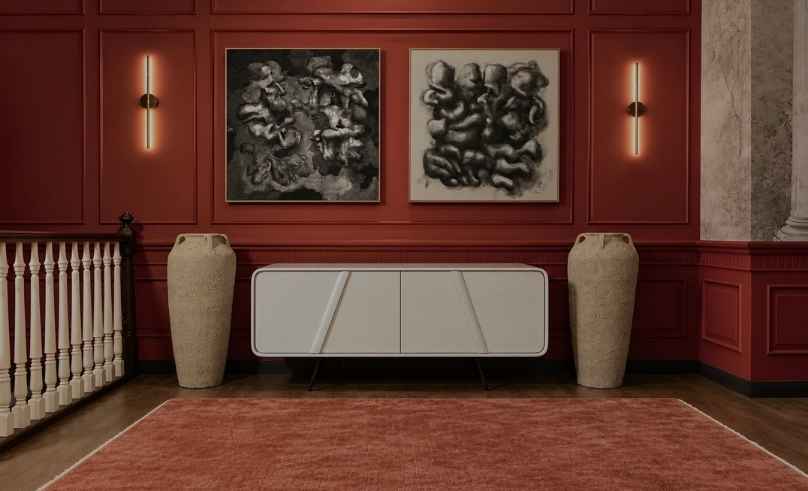
Nothing here is really for sale, at least, not in the ordinary sense. What's on offer is the relief of not having to imagine how a sofa, a linen and a 19th-century arch might get along in the same room, because somebody has already done that imagining, wired it, upholstered it, and left the lights on for you.
"The strategy behind the showroom was not about showcasing the furniture," says Omar El Sisi, SIGNÉ's founder and chief designer. "It was about showcasing an idea of client hospitality through a full tailored design experience. Clients get to see a prototype of how the design process can transform a space, and actually feel the furniture, fabrics and colours through their own personal experience, rather than just viewing products in a commercial showroom setting."
Geography does a fair amount of the storytelling here. El Sisi is unusually candid about stage-managing the walk up: shoppers spend the ride absorbing showroom after showroom, their eye trained on repetition, before a door interrupts the pattern entirely.
"They feel like they've been transformed into another dimension," he says, "and that is why it is a Time-Capsule."
When you step past the gate the room greets you like a decade that took a scenic detour. Arches on loan from a sun-drenched Cairo of daydreams, cradling brand-new furniture.
"I have always been inspired by the past," El Sisi says. "I think it carries a lot of authenticity, which is a strong subject for strong identity design."
The result is an argument in progress, historical references and contemporary pieces seated at the same table, occasionally talking over each other.
Chairs, in this particular story, do a startling amount of narrative work. Mohamed Mohy, who founded Oak Living Interiors puts it plainly: "We don't design around a style, we design around experience."
-77594b40-b8ca-456d-a613-23237c969e3c.jpg)
His pieces run on honest materials and soft, sculptural forms built to reward a hand more than a glance. "Furniture is not an addition to architecture," he says. "It is an integral part of it. It defines the atmosphere, establishes the visual rhythm, and gives meaning to every surrounding element."
The fabric plays a similarly patient game. Seda's selection skips pattern almost entirely in favour of plain velvets and textured linens. "The focus was about highlighting the furniture and pieces itself and at the same time invite people to feel the fabric's richness and functional comfort rather than admire its looks."
Underfoot, rugs curated from Kahhal 1871 thread a genuinely old Cairo into a room that is otherwise unapologetically new in its construction.
Ask El Sisi what three brands gain from sharing one address instead of three separate ones, and his answer plays like an actual grievance about how the design industry usually operates. Furniture and fabric decisions, he says, tend to arrive "later on, at a later stage," bolted onto a finished room "as an FF&E guided by professional design consultancy" rather than developed alongside it from day one.
-38d0fecb-d894-4b90-9c64-366b4fe49339.jpg)
Housing all three together, in his telling, spares a client the specific anxiety of trying to conjure a finished room out of a stack of unrelated swatches on a table.
"It creates a complete visualisation," he says, "and opens a lot of creative possibilities for the clients. They feel it's all under one roof and not overwhelmed with the details."
Ask what he hopes people carry out with them, and the answer skips furniture entirely. "A feeling of possibilities," he says, "to challenge the user to visualise how creative spaces can feel by mixing different design references through their own personal identity."
Fair enough. Most visitors will happily settle for the smaller miracle already sitting in front of them: an entire pitch meeting, dressed as a room, that nobody had to sit through.